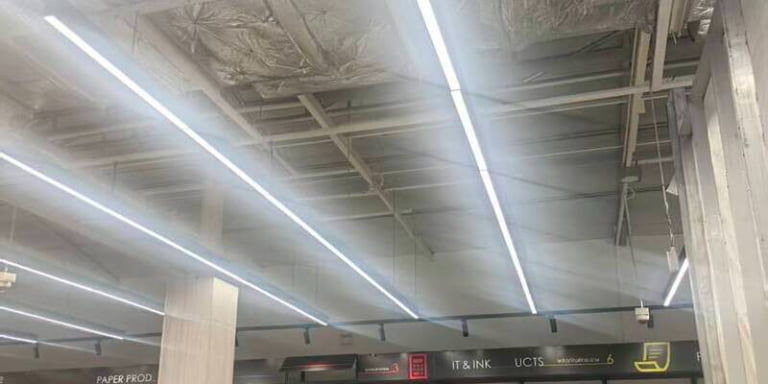
Modern Linear Suspension Lighting: What Should B2B Buyers Really Evaluate Beyond Aesthetics?
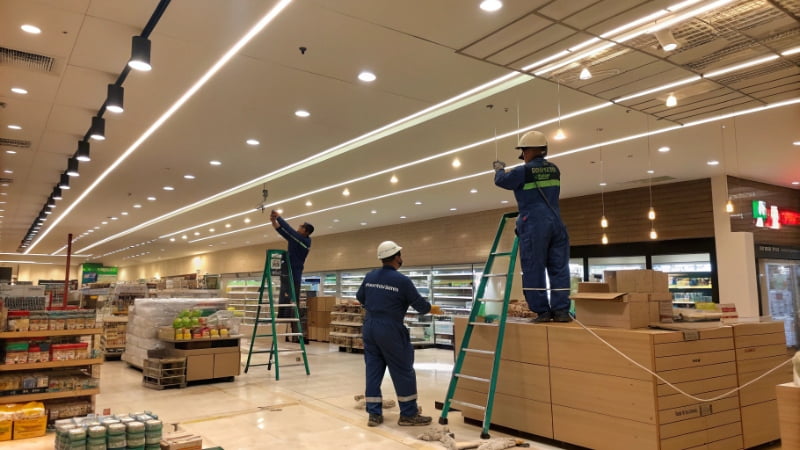
Modern linear suspension lighting seems simple enough to specify — until a project goes wrong. I've seen contractors return to us months after installation because the fixtures they sourced elsewhere produced unbearable glare in open-plan offices, or because cheap drivers failed within a year. The real challenge isn't finding a fixture that looks modern; it's finding one that performs like it should.
Modern linear suspension lighting is defined not only by its clean, contemporary design but by its advanced optical engineering, electrical reliability, thermal management, and long-term cost efficiency. B2B buyers who evaluate these technical and functional variables — rather than focusing on aesthetics and initial price alone — consistently avoid costly project rework, premature fixture failure, and end-user dissatisfaction.
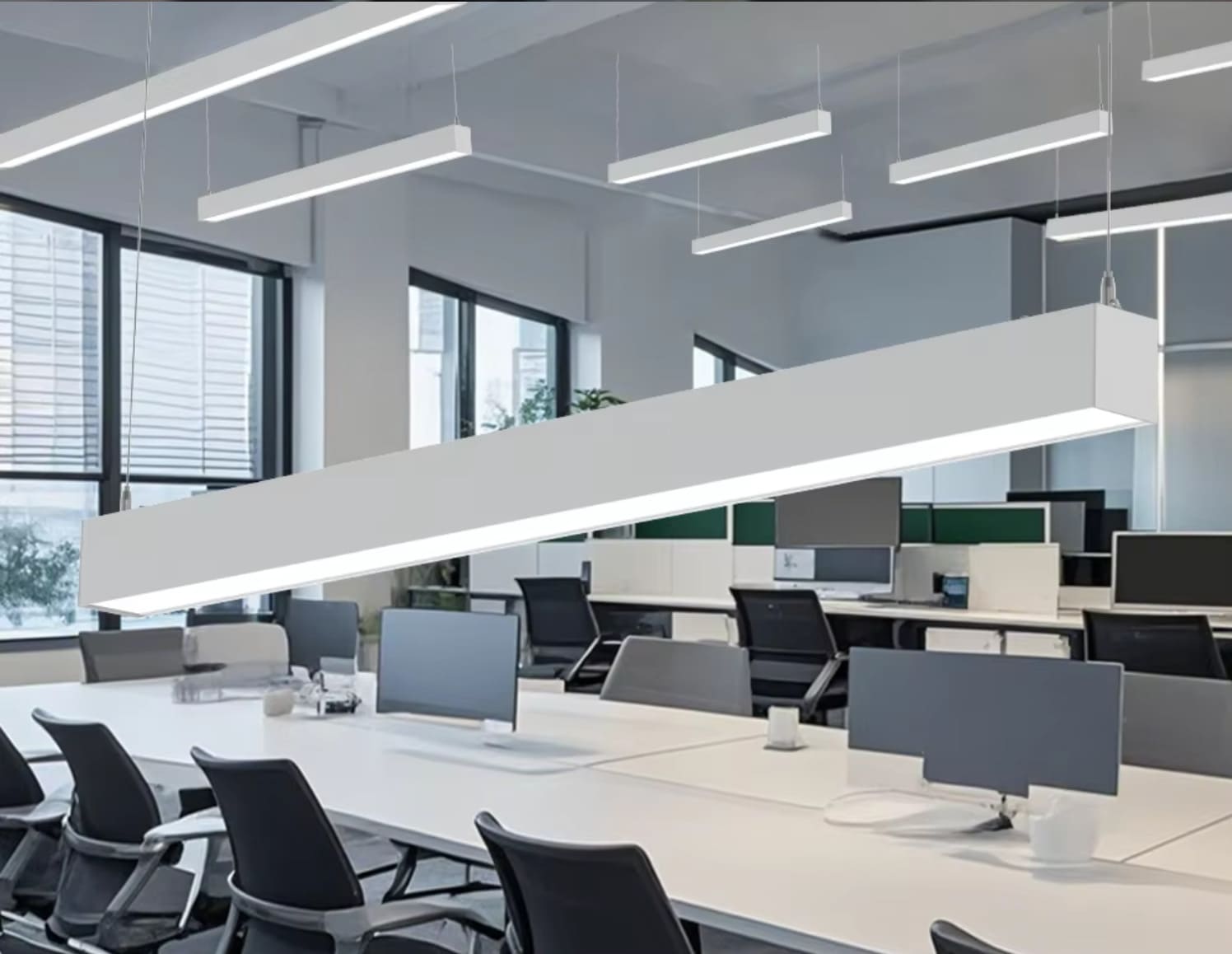
But how do you actually evaluate these variables when comparing suppliers and product lines? Below, I'll break down the critical selection criteria I walk through with our wholesale and project partners — covering everything from optical performance and driver quality to total cost of ownership. Each section tackles a specific question that, in my experience, separates a successful installation from a problematic one.
What Actually Makes Linear Suspension Lighting "Modern"?
Many buyers equate "modern" with a slim profile and minimalist aesthetics. That's only half the story. A truly modern fixture can look identical to a cheap imitation but deliver dramatically different performance in the field.
A fixture earns the label "modern linear suspension lighting" when it integrates advanced optical design (precision lenses or microprism diffusers), high-efficacy LED modules, intelligent driver electronics, and engineered thermal pathways — all within a form factor optimized for both visual appeal and installation flexibility.
Beyond the Profile: Engineering That Defines Performance
The sleek, extruded aluminum profile of a linear suspension fixture is what most buyers notice first. And rightfully so — profile design affects aesthetics, mounting versatility, and heat dissipation. But here's what I always tell our partners: two profiles that look identical on a spec sheet can behave very differently once installed.
The differences come down to the engineering details hidden inside:
- Optical system: Does the fixture use a simple frosted polycarbonate cover, or a purpose-designed microprism or lens array? The former scatters light and reduces efficiency. The latter controls beam distribution precisely, improving both uniformity and glare control.
- LED module quality: The brand and bin grade of the LED chips determine color consistency (MacAdam ellipse step), lumen maintenance over time (L70/L80 ratings), and spectral quality (CRI/R9 values).
- Driver electronics: The LED driver is the "brain" of the fixture. Its quality determines dimming compatibility, flicker performance, power factor, and operational lifespan.
- Thermal architecture: LEDs generate heat. How that heat moves from the LED junction through the PCB, into the housing, and out into ambient air determines how long the fixture maintains its rated output.
| Feature | Basic "Modern Look" Fixture | Truly Modern Linear Suspension Fixture |
|---|---|---|
| Optical Control | Frosted diffuser, uncontrolled beam | Microprism / lens array, defined beam angle |
| LED Chip Grade | Unspecified bin, 3–5 SDCM | Named brand, ≤3 SDCM (MacAdam step) |
| Driver Quality | No-name, limited dimming | Branded (Philips, Lifud, etc.), DALI/0-10V ready |
| Thermal Design | Thin housing, minimal contact area | Engineered aluminum extrusion with thermal bridging |
| Flicker | Often >30% at low dim levels | <1% IEEE-compliant flicker-free |
In one project we supported for a Middle Eastern office fit-out, the contractor's initial supplier provided fixtures with virtually the same profile dimensions as ours. On paper, they looked equivalent. Within six months, the diffusers yellowed due to poor thermal management, and the drivers produced visible flicker during DALI dimming below 20%. The replacement order came to us. The lesson: "modern" is a performance standard, not just a design language.
How Do You Match Modern Linear Suspension Lighting to Specific Applications?
Choosing a fixture without deeply considering the application environment is one of the most common — and most expensive — mistakes I see. A linear pendant perfect for a retail showroom can be completely wrong for a corporate boardroom.
Application-specific selection of modern linear suspension lighting requires matching optical parameters (beam angle, UGR, luminous flux distribution) and electrical characteristics (dimming protocol, wattage, CCT) to the tasks, occupants, and standards governing each space.
Understanding UGR: The Glare Metric Most Buyers Overlook
Unified Glare Rating (UGR) is arguably the single most critical parameter for modern linear suspension lighting in commercial environments — and the one most frequently ignored during procurement.
UGR quantifies how much discomfort glare occupants experience from a luminaire in a given room geometry. The lower the number, the less glare.
- UGR ≤ 19: Required for most office, educational, and healthcare environments under EN 12464-1 and similar standards.
- UGR ≤ 22: Acceptable for general commercial areas and some industrial settings.
- UGR ≤ 25: Adequate for corridors, circulation areas, and some retail environments.
> Key misconception: UGR is not an inherent property of the fixture alone. It depends on the fixture's luminous intensity distribution, mounting height, room dimensions, and surface reflectances. A supplier who states "UGR<19" without specifying the reference room conditions is giving you incomplete — potentially misleading — data.
When I work with our wholesale partners, I always recommend requesting the full UGR table or photometric file (IES/LDT) so their lighting designers can verify UGR in the actual project room geometry. We provide these files for all our linear suspension products as standard.
Beam Angle and Light Distribution
Modern linear suspension fixtures typically offer several distribution options:
- Direct (downward): Most common. Efficient for task planes but can create harsh ceiling-to-fixture contrast.
- Indirect (upward): Bounces light off the ceiling. Produces soft, diffused ambient light with minimal glare. Less energy-efficient due to ceiling absorption losses.
- Direct/Indirect (combined): The preferred option for most modern offices and hospitality spaces. Splits output — commonly 60/40 or 70/30 direct-to-indirect — balancing task illumination with a comfortable, well-lit ceiling plane.
For a recent project we supplied in Southeast Asia — a co-working space spanning 2,000 square meters — the developer initially spec'd 100% direct fixtures. After I shared photometric simulations showing a UGR of 24 at standard desk height, they switched to our direct/indirect version. UGR dropped to 17. End-user satisfaction was notably higher, and the developer reported zero glare complaints during post-occupancy review.
CCT and CRI: Getting Color Right
| Parameter | Retail / Hospitality | Office / Educational | Industrial / Warehouse |
|---|---|---|---|
| CCT | 3000K–3500K (warm, inviting) | 4000K–5000K (neutral, alert) | 5000K–6500K (bright, high-visibility) |
| CRI | ≥90 (accurate merchandise colors) | ≥80 (comfortable, adequate) | ≥70 (functional) |
| R9 (deep red) | ≥50 (critical for food, textiles) | ≥0 (less critical) | Not typically specified |
Selecting the wrong CCT or CRI doesn't just look bad — it actively undermines the function of the space. I've had a South American importer contact us because their end-customer, a clothing retailer, couldn't sell certain garment colors under 6500K linear pendants with a CRI of 72. Merchandise looked washed out and artificial. Replacing with 3500K, CRI 95 fixtures transformed the shopping experience. Product selection is always application selection.
Why Does Driver Quality Matter More Than Most Buyers Realize?
The LED driver is the component most likely to fail first in any modern linear suspension lighting system. Yet it receives the least scrutiny during the purchasing process. I see this repeatedly — buyers compare wattage and lumen output but never ask about the driver.
LED driver quality directly determines the operational lifespan, dimming smoothness, flicker performance, power factor, and system compatibility of modern linear suspension lighting. A fixture with premium LEDs and a cheap driver is a ticking clock for project callbacks.
What to Ask Your Supplier About Driver Specifications
Here are the driver parameters I recommend every B2B buyer evaluate:
- Brand and certification: Drivers from established brands (Philips Xitanium, Osram, Lifud, Boke, Sosen) carry known reliability track records. Ask for UL, CE, or CB certifications appropriate to your target market.
- Rated lifespan at operating temperature: A driver rated for 50,000 hours at 25°C may only last 25,000 hours at 50°C inside a poorly ventilated fixture. Ask for the Tc point temperature and the lifespan at that temperature.
- Dimming protocol compatibility: DALI-2, 0-10V, Triac/phase-cut, or Casambi wireless? Mismatched dimming protocols cause flickering, buzzing, and limited dimming range — problems that show up only after installation.
- Flicker percentage and frequency: IEEE 1789 recommends <1% flicker at frequencies below 200Hz. Low-cost drivers often exhibit 15–40% flicker at low dimming levels. This causes headaches and eye strain — a liability in office and educational environments.
- Power factor: A power factor ≥ 0.95 is expected in commercial installations. Low PF fixtures draw excess reactive power, which increases energy costs in markets where utilities charge for reactive power.
- Surge protection rating: In emerging markets with unstable power grids, a 2kV or 4kV surge protection rating within the driver is essential. Without it, voltage spikes destroy drivers — sometimes within weeks.
The Real-World Cost of Cheap Drivers
We once had a West African importer who had been sourcing linear suspension fixtures from another factory. The fixtures looked identical to ours. The price was about 15% lower. Within 8 months, roughly 12% of the fixtures had driver failures across multiple installation sites. The importer bore the full cost of warranty replacements, reinstallation labor, and damaged customer relationships.
When they switched to our products — which use Lifud or Philips drivers with 4kV surge protection — the failure rate over the same timeframe dropped to under 0.5%. The 15% price savings on the initial purchase was wiped out many times over by field failures. This is exactly the kind of risk that becomes invisible if you evaluate products only on spec sheets and unit price.
How Do You Calculate Total Cost of Ownership for Linear Suspension Lighting?
Initial purchase price is only one component — and often not the largest one — of the total cost of owning modern linear suspension lighting over its service life. Buyers who ignore this reality consistently underestimate project costs.
The Total Cost of Ownership (TCO) for modern linear suspension lighting includes purchase price, shipping, installation, energy consumption over the fixture's lifespan, maintenance and replacement costs, and the economic impact of system downtime or rework. Evaluating TCO rather than unit price protects margins and project viability.
Breaking Down TCO: A Practical Framework
Let me walk through how I help our partners calculate TCO. Suppose you're specifying 200 linear suspension fixtures for a commercial office project with a 10-year evaluation horizon.
| Cost Component | Cheap Fixture (Example) | Quality Fixture (Example) |
|---|---|---|
| Unit price | $35 | $55 |
| Total purchase (200 units) | $7,000 | $11,000 |
| Wattage per fixture | 45W | 36W |
| Annual energy cost (12hrs/day, $0.10/kWh) | $3,942 | $3,154 |
| 10-year energy cost | $39,420 | $31,536 |
| Expected replacements (10yr) | 30% failure = 60 units | 3% failure = 6 units |
| Replacement + labor cost | $4,200 | $420 |
| 10-year TCO | $50,620 | $42,956 |
In this simplified scenario, the "expensive" fixture saves $7,664 over 10 years — an 18% total cost advantage despite costing 57% more per unit.
Key TCO Variables to Watch
- Luminous efficacy (lm/W): Higher efficacy means less energy consumed per unit of useful light. A well-designed modern linear suspension fixture should deliver ≥120 lm/W at the system level (not just at the LED chip level).
- Lumen maintenance (L70/L80): How much light output the fixture retains over time. An L80 at 50,000 hours means the fixture still produces 80% of its initial lumens at 50,000 operating hours. Fixtures with poor thermal management degrade faster.
- Warranty terms: Look beyond duration. What does the warranty actually cover? Does it include driver and LED module failures? Does it cover labor? What's the claims process?
- Modular design: Can you replace the LED module or driver independently, or must you replace the entire fixture? Modular design dramatically reduces maintenance cost.
> Pro tip from our engineering team: Always request lumen maintenance data at the system level, not just the LED chip level. A chip rated L70 at 100,000 hours means little if the fixture's thermal design pushes the junction temperature so high that actual in-fixture L70 is only 30,000 hours.
What Role Does Thermal Management Play in Fixture Longevity?
Heat is the silent killer of LED fixtures. Modern linear suspension lighting generates less heat than legacy technologies, but the heat it does produce must be managed effectively. This is where many budget fixtures cut corners — and where long-term reliability diverges most dramatically between products.
Effective thermal management in modern linear suspension lighting determines LED lifespan, lumen maintenance, color stability, and driver reliability. Fixtures with inadequate thermal pathways may look identical initially but degrade significantly faster in both light output and color quality.
How to Evaluate Thermal Design During Procurement
You don't need to be a thermal engineer to assess this. Here's what I tell our buyers to look for:
- Housing material and thickness: High-quality extruded aluminum profiles with sufficient mass act as heat sinks. Thin steel or plastic housings trap heat.
- PCB-to-housing interface: Is the LED PCB mounted directly onto the aluminum extrusion with thermal paste or a thermal pad? Or is there an air gap? Direct contact is essential for efficient heat transfer.
- Tc point data: Ask the manufacturer for the measured temperature at the driver's Tc point during normal operation. If it exceeds the driver manufacturer's rated Tc max, the driver will fail prematurely.
- Ambient temperature rating (Ta): Most fixtures are rated for a maximum ambient temperature of 25°C or 35°C. If you're installing in a Middle Eastern warehouse without climate control — where ambient can reach 50°C — this matters enormously.
The Color Shift Problem Nobody Talks About
Poor thermal management doesn't just reduce brightness over time. It also causes color shift — a gradual change in the fixture's color temperature. I've seen installations where fixtures that started at 4000K drifted to 4500K or even 5000K within two years because excessive junction temperatures accelerated phosphor degradation.
In a hospitality or retail environment, this is unacceptable. Fixtures within the same space begin producing noticeably different colors. The only fix is full replacement.
This is why we invest significantly in our aluminum die-casting and extrusion capabilities at our Jiangmen facilities. We control the housing production process directly, allowing us to optimize thermal pathways
Christina
B2B Sales & Product Expert
10+ years in LED & solar lighting manufacturing. Helping global wholesalers and EPC contractors source reliable OEM/ODM solutions from China.
Looking for a Reliable Lighting Partner?
We support low MOQ and offer customized engineering for commercial, industrial, and solar lighting projects globally. Partner with our Zhongshan/Jiangmen dual factories today.